


Lightbits redefines how storage is managed and delivered in OpenStack and KVM cloud environments.
5 Reasons Why Lightbits is Ideal for OpenStack
Unmatched Parallel Performance
Lightbits storage software enables you to effortlessly create hundreds of new PVCs at scale without compromising IOPS or increasing latency for your running applications.
Peak Performance for Every Volume
Lightbits ensures unmatched IOPS and ultra-low latency, delivering industry-leading performance at scale even when demand for volumes grows exponentially.
Effortless Live Migration with OpenStack Volume Retype
Disaggregated Storage
Scalability, Resiliency and Cost Effectiveness
Customer Stories
Lightbits’ high-performance block storage solution has addressed our storage challenges, unlocking the full potential of Crusoe Cloud’s infrastructure and empowering users to pursue innovative research and development in the field of climate science and AI. Together, Crusoe Cloud and Lightbits are driving the future of climate-focused computing toward a more sustainable and efficient tomorrow.
Mike McDonald, Product Manager, Crusoe

What is OpenStack Cinder Used For?
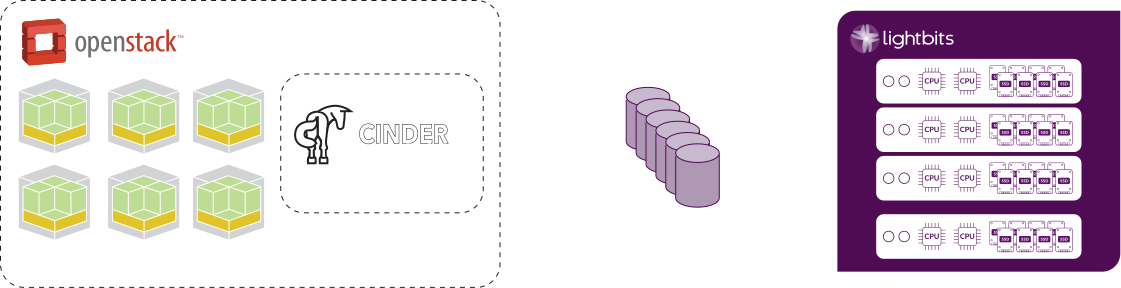
Lightbits OpenStack Cinder driver provisions and mounts highly available, replicated Lightbits volumes as NVMe devices to OpenStack compute nodes. The orchestration and management of data is controlled directly from OpenStack ensuring the seamless integration with any OpenStack cloud environment.
Ceph Storage Augmentation for OpenStack Clouds
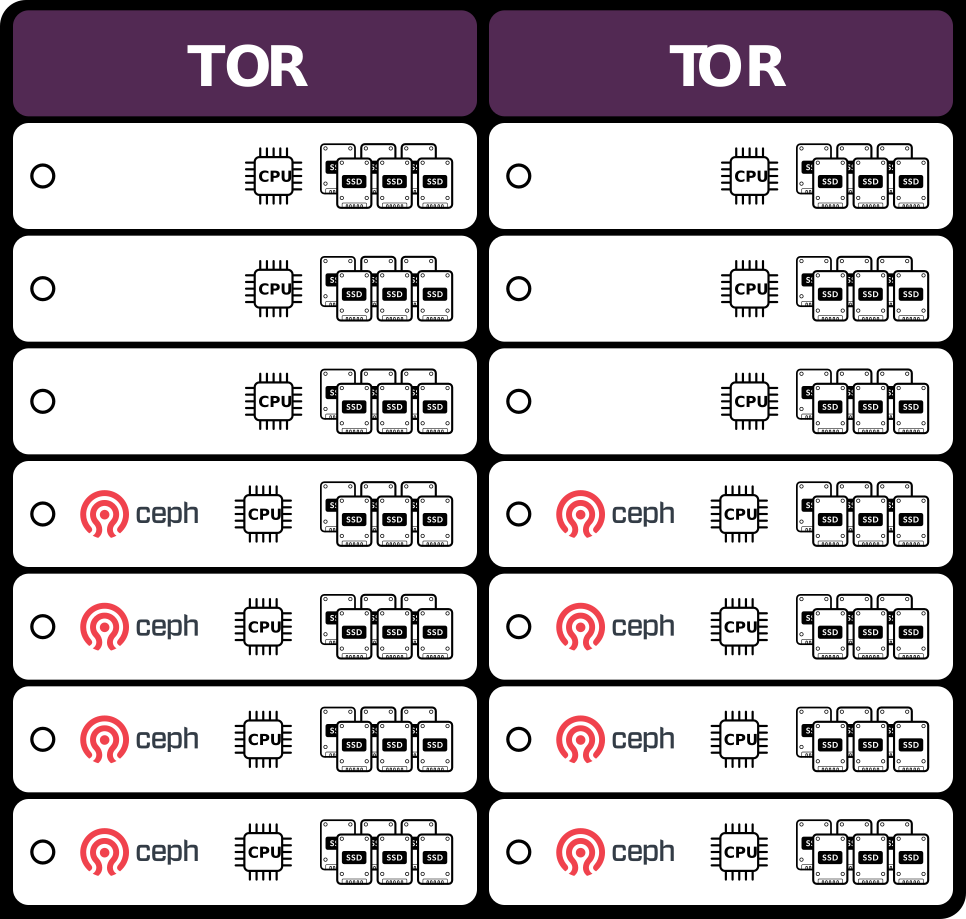
With open source, software defined architecture you have the flexibility to choose either footprint for expansion–Lightbits or Ceph Storage. Procurement and maintenance are simple with a single server specification and set of hardware.
While Ceph offers open-source advantages and unified storage protocols, Lightbits is uniquely engineered to deliver 16x better performance, efficiency, and operational simplicity at scale under demanding production workloads, such as SQL, NoSQL, real-time, and vector databases.
OpenStack Cloud Storage FAQs
What storage services are included in OpenStack (Cinder, Swift, Manila)?
How does OpenStack storage work in private clouds?
OpenStack Cloud Storage: Common Questions Answered
What storage services are included in OpenStack (Cinder, Swift, Manila)?
- Cinder provides persistent block storage to VMs. Lightbits LightOS provides a Cinder Driver that replaces slower backends, such as iSCSI or Ceph RBD, with NVMe/TCP. It allows OpenStack to treat Lightbits storage as a high-speed, scalable pool of flash. Use cases include databases (SQL/NoSQL), boot disks, and any application requiring low-latency performance.
- OpenStack clouds use Swift for massive-scale object storage, Lightbits block storage is used as a performance-heavy workload tier that Swift isn’t designed to handle. Swift use cases include storing large amounts of static data like images, video files, backups, and machine learning datasets.
- Manila provides a Shared File System service. Platform architects often use Lightbits Cinder volumes as the underlying storage for high-performance file servers that then export NFS shares to the rest of the cloud.
How does OpenStack storage work in private clouds?
In a private cloud, OpenStack storage works as a collection of specialized services that abstract physical hardware into virtualized pools. Lightbits makes provisioning storage services significantly faster and more efficient. Lightbits Cinder driver acts as the translator between OpenStack’s high-level commands and the Lightbits storage cluster.
OpenStack Cloud Storage: Common Questions Answered
- What is the best block storage backend for OpenStack Cinder? The best backend depends on workload needs, but NVMe/TCP-based software-defined storage (e.g., Lightbits) is increasingly preferred for high-performance, low-latency environments.
- How does OpenStack handle HA storage? Through backend replication/erasure coding, multipathing, and failover mechanisms managed by Cinder and the storage platform.
- What are the performance requirements for OpenStack workloads? Modern workloads require sub-ms latency, high IOPS, and consistent performance under load.
- How does OpenStack storage integrate with compute and networking? Via Cinder drivers connecting storage to Nova and Neutron, forming a tightly coupled data path.
- How does Ceph compare to other OpenStack storage backends? Ceph offers flexibility and scalability but can introduce latency and operational complexity, whereas modern SDS solutions like Lightbits LightOS prioritize performance and simplicity.